above
higher than something and not touching it; also higher than a level, number, or standard
- Start with one rule: above means higher than something without touching it.
- On means touching the surface. Above means higher than it, without contact.
- When the noun is a level or standard, above means higher than that level: above average, above zero, above your level.
Controls
Drag to rotate / Scroll to zoom / Pinch to zoom
Examples
Spatial examples
The lamp is above the table.
A small window is above the bed.
Related prepositions
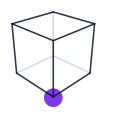
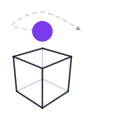
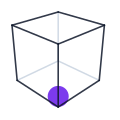
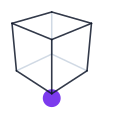
Key differences
See on / over / above / below in one picture
The dashed rectangle is the reference object. Compare contact, crossing, and higher/lower range.
Above does not mainly mean directly over the center. Its core idea is higher than something. It usually does not involve contact or crossing. If there is contact, use on. If crossing is central, use over.
On is for surface contact. Above is for a higher position without touching.
Over often adds a crossing or covering idea. Above only says that something is higher.
Below is the opposite direction. Above means higher than; below means lower than.
Quick check questions (decision tree)
Is one thing at a higher level without needing to cover or touch the other?
higher than something and not touching it; also higher than a level, number, or standard
Do you need on instead because it is for surface contact?
On is for surface contact. Above is for a higher position without touching.
Do you need over instead because it often adds a crossing or covering idea?
Over often adds a crossing or covering idea. Above only says that something is higher.
Do you need below instead because it is the opposite direction?
Below is the opposite direction. Above means higher than; below means lower than.
Common collocations
Spatial position
Numbers and standards
Ability and abstract range
Common mistakes
Avoid: The book is above the table. (when the book is touching the table)
Use: The book is on the table.
Reason: Use on for surface contact. Above means higher than something without touching it.
Avoid: The bird flew above the wall and crossed it.
Use: The bird flew over the wall.
Reason: When the crossing path matters, over is usually the better choice.
Avoid: The score is over average.
Use: The score is above average.
Reason: The standard collocation is above average when you compare with a level or standard.
Mini quiz
Question 1
Choose the correct preposition: The lamp is ___ the table.
Choose an answer
Question 2
Choose the correct preposition: Her score is ___ average.
Choose an answer
Question 3
Choose the correct preposition: A bird flew ___ the wall.
Choose an answer
Quick FAQ
What is the core meaning of above?+
Above means higher than something, usually without touching it.
What is the difference between above and on?+
On means contact with a surface. Above means a higher position without contact.
What is the difference between above and over?+
Above focuses on higher position. Over often adds crossing or covering meaning.
Why do we say above average, not over average?+
Because above is the standard word for being higher than a level, number, or standard such as average, zero, or the limit.
Can above mean not exactly straight over the center?+
Yes. Above means higher than something. It does not have to be exactly centered over it.
Can above be used for numbers and levels?+
Yes. Common patterns include above average, above zero, above sea level, and above your level.
What is a quick memory rule for above?+
Think: higher than, not touching. Then anchor it with a phrase like above average.