beside
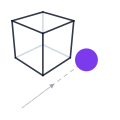
at the side of; next to, usually very close
- Beside marks side-by-side position with short distance.
- It overlaps with next to, but often sounds slightly more formal.
- Use it for side relation only, not top/bottom/inside relations.
Controls
Drag to rotate / Scroll to zoom / Pinch to zoom
Examples
Spatial examples
Please sit beside me.
A small table stands beside the sofa.
Related prepositions



Key differences
Beside means side-by-side and close. Learners often mix it with next to, by, and near. The key is whether you mean strict side relation or only general proximity.
Next to is the tightest adjacency. Beside is also close, but can be slightly less strict.
By is broader and more conversational. Beside is more specific for side relation.
Near marks short distance only. Beside adds side-by-side orientation.
Quick check questions (decision tree)
Are two things immediately side by side at roughly the same level?
at the side of; next to, usually very close
Do you need next to instead because it is the tightest adjacency?
Next to is the tightest adjacency. Beside is also close, but can be slightly less strict.
Do you need by instead because it is broader and more conversational?
By is broader and more conversational. Beside is more specific for side relation.
Do you need near instead because it marks short distance only?
Near marks short distance only. Beside adds side-by-side orientation.
Common collocations
People and Position
Objects and Places
High-frequency Chunks
Common mistakes
Avoid: The cafe is beside the station. (when you only mean general proximity)
Use: The cafe is near the station.
Reason: Use near for broad proximity; beside implies side relation.
Avoid: Put the cup beside the table. (when you mean on the surface)
Use: Put the cup on the table.
Reason: Beside means at the side, not on the surface.
Avoid: He sat near me in a tight seating row.
Use: He sat beside me.
Reason: For clear side-by-side adjacency, beside/next to is stronger than near.
Mini quiz
Question 1
Choose the correct preposition: Please sit ___ me so we can read together.
Choose an answer
Question 2
Choose the correct preposition: The lamp is ___ the bed, not on it.
Choose an answer
Question 3
Choose the better word: The supermarket is ___ the station (general proximity only).
Choose an answer
Quick FAQ
What is the core meaning of beside?+
Beside means at the side of something, usually with close side-by-side relation.
What is the difference between beside and next to?+
Both can mean nearby at the side. Next to is often the tightest adjacency; beside can be slightly less strict and more neutral in tone.
How is beside different from near?+
Near means close in distance only. Beside adds side orientation and clearer adjacency.
How is beside different from by?+
By is broader and very conversational. Beside is more specific for side-by-side spatial relation.
Can beside be used for time expressions?+
Not typically. For time, use prepositions such as at, in, on, and by.
What is a common learner mistake with beside?+
Using beside for surface contact (should be on) or for broad proximity without side relation (often near).
What collocations should beginners memorize first?+
Useful starters: sit beside me, beside the window, beside the road, right beside.
What is a 30-second memory rule for beside?+
Ask one question: Is it side-by-side and close? If yes, choose beside. If it is only nearby, use near.