in
inside; enclosed by boundaries
- Fully contained within a space.
- Use in for enclosed, not on for surfaces.
Scene category
Controls
Drag to rotate / Scroll to zoom / Pinch to zoom
Examples
Spatial examples
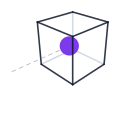
The ball is in the box.
The keys are in the drawer.
Time examples
Practice this time expression: in the morning.
Another common pattern is: in the afternoon.
Related prepositions



Key differences
In focuses on being inside a boundary; compared with inside/into/on, it describes a static position.
Inside emphasizes the boundary and interior space more strongly.
Into is motion from outside to inside; in is a static location.
On means touching a surface; in means enclosed within.
Quick check questions (decision tree)
Is the object enclosed by the boundaries of a place, container, or area?
inside; enclosed by boundaries
Do you need inside instead because it emphasizes the boundary and interior space more strongly?
Inside emphasizes the boundary and interior space more strongly.
Do you need into instead because it is motion from outside to inside; in is a static location?
Into is motion from outside to inside; in is a static location.
Do you need on instead because it means touching a surface; in means enclosed within?
On means touching a surface; in means enclosed within.
Common collocations
Spatial
Time
Abstract states
Common mistakes
Avoid: The keys are at my bag.
Use: The keys are in my bag.
Reason: A bag is an enclosed container, so use in for inside position.
Avoid: There is a bird in the roof.
Use: There is a bird on the roof.
Reason: A roof is treated as a surface, so use on for contact.
Avoid: The cat jumped in the box.
Use: The cat jumped into the box.
Reason: Jumped expresses motion into a space, so into is needed.
Avoid: I will finish this in Monday.
Use: I will finish this on Monday.
Reason: Use on with days; in is for months, years, or longer periods.
Mini quiz
Question 1
My phone is ___ my bag.
Choose an answer
Question 2
We usually study ___ the morning.
Choose an answer
Question 3
She walked ___ the room and sat down.
Choose an answer
Quick FAQ
What is the core meaning of the preposition in?+
The core meaning is inside a boundary. Use in when a person or thing is enclosed by a space. Example: The keys are in the bag.
How do I quickly choose between in and on?+
Ask one question: is it touching a surface? Use on for surface contact, and in for enclosed space. Example: in the box vs on the box.
What is the difference between in and into?+
In is a static position; into is movement from outside to inside. Example: The cat is in the box. / The cat jumped into the box.
How is in used in time expressions?+
Use in with larger time units: months, years, seasons, and parts of the day. Example: in July, in 2026, in winter, in the morning.
When should I not use in for time?+
Do not use in with specific days or dates. Use on Monday / on July 1, and use at for exact clock time.
What is a common learner mistake with in?+
Learners overuse in for surface situations. Say on the roof, not in the roof; say in my bag, not at my bag.
What are common collocations with in?+
High-frequency collocations include: in the room, in the morning, in 2026, in trouble, in a hurry, and in love.
What is a 30-second memory rule for in?+
Use this rule: inside a boundary -> in. Then rehearse a contrast pair: in the box (inside) vs on the box (surface).