along
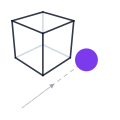
along; following a line
- Following a path or edge.
- Often with roads or rivers.
Scene category
Controls
Drag to rotate / Scroll to zoom / Pinch to zoom
Examples
Spatial examples
We walked along the river.
The lamp posts line up along the street.
Dynamic examples
Watch the marker move along the road.
Then trace a second path along the edge.
Related prepositions
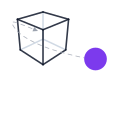
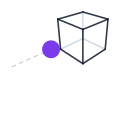
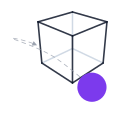
Key differences
along mainly shows movement following a line or edge; compare it with similar dynamic prepositions to avoid path confusion.
along focuses on movement following a line or edge, while across usually marks a different path relation.
along highlights movement following a line or edge; through often changes direction or endpoint meaning.
Quick check questions (decision tree)
Does the movement or position follow the length of a road, edge, river, or path?
along; following a line
Does the route cut from one side of an area to the other instead of following its length?
Yes -> use across. Along follows a line or edge; across crosses the width of an area.
Does the route enter an enclosed space and pass inside it?
Yes -> use through. Along stays with a line or edge; through travels inside a space or opening.
Are several things positioned at different points beside the same road, river, wall, or line?
Yes -> along also describes distribution: trees along the road / shops along the river.
Common collocations
Linear routes
Edges and borders
Abstract paths
Common mistakes
Avoid: The marker moved across the road.
Use: The marker moved along the road.
Reason: Use along for movement following a line or edge; across changes the path relation.
Avoid: The ball rolled through the river.
Use: The ball rolled along the river.
Reason: along matches the intended motion; through shifts direction or endpoint meaning.
Mini quiz
Question 1
Choose the correct preposition: ___ the road.
Choose an answer
Question 2
Choose the correct preposition: ___ the river.
Choose an answer
Question 3
Choose the correct preposition: ___ the edge.
Choose an answer
Quick FAQ
What does "along" mean?+
along; following a line. Rule: Following a path or edge.
When should I use "along"?+
Use it when this relation is true: Following a path or edge. Often with roads or rivers. Rule: We walked along the river.
What is the difference between "along" and "across"?+
along focuses on movement following a line or edge, while across usually marks a different path relation. Rule: across the street
What is the difference between "along" and "through"?+
along highlights movement following a line or edge; through often changes direction or endpoint meaning. Rule: through the route
Can "along" be used for time expressions?+
Mostly no. This preposition is primarily spatial/dynamic; use dedicated time prepositions when needed.
What is a common mistake when using "along"?+
A frequent beginner mistake is: Avoid: The marker moved across the road. Use: The marker moved along the road. Reason: Use along for movement following a line or edge; across changes the path relation.
What are common collocations with "along"?+
High-frequency examples: along the road, along the river, along the beach, along the wall, along the corridor, along the street
How does "along" express movement?+
Track the movement path first, then confirm start point, direction, and endpoint.