past
past; beyond a point (passing it)
- Space: pass a point/place and continue (walk past the school).
- Time: later than a time (It's past 3 o'clock) or clock-reading (ten past six).
Scene category
Controls
Drag to rotate / Scroll to zoom / Pinch to zoom
Examples
Spatial examples
Walk past the school.
The bus went past the stop.
Time examples
It's ten past six.
It's just past midnight.
It's past 3 o'clock.
Dynamic examples
Go past the bank and turn left.
A car sped past us.
Related prepositions

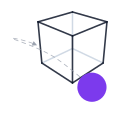
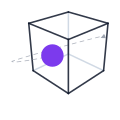
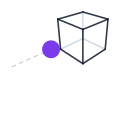
Key differences
Past mainly means "passing a point and going beyond it". In time, it can mean "later than a time" (It's past 3 o'clock) or clock-reading (ten past six). Learners often mix past vs to (clock) and past vs after (sequence).
Clock reading: past is minutes after the hour; to is minutes before the next hour.
After is simple time order (after class). Past is common for later than a time (It's past midnight) or passing a place.
Beyond focuses on being farther than a point/limit. Past focuses on moving past a point and continuing.
Quick check questions (decision tree)
Does movement or time continue beyond a reference point?
past; beyond a point (passing it)
In a clock reading, are you counting minutes before the next hour?
Clock reading: past is minutes after the hour; to is minutes before the next hour.
Do you need after instead because it is simple time order (after class)?
After is simple time order (after class). Past is common for later than a time (It's past midnight) or passing a place.
Do you need beyond instead because it focuses on being farther than a point/limit?
Beyond focuses on being farther than a point/limit. Past focuses on moving past a point and continuing.
Common collocations
Routes and passing (space)
Clock time
Beyond a point/limit
Common mistakes
Avoid: It's ten past six. (when it is 5:50)
Use: It's ten to six.
Reason: In clock time, past = minutes after; to = minutes before the next hour.
Avoid: The bus past the stop.
Use: The bus went past the stop.
Reason: Past is a preposition, so it needs a verb phrase like go/walk/drive past.
Avoid: I saw him past week.
Use: I saw him last week.
Reason: Use last for "previous" time periods (last week/month).
Mini quiz
Question 1
Choose the correct preposition: It's ten ___ six.
Choose an answer
Question 2
Choose the correct preposition: Go ___ the bank and turn left.
Choose an answer
Question 3
Choose the correct preposition: We're already ___ the deadline.
Choose an answer
Quick FAQ
What is the core meaning of past?+
Past means passing a point/place and going beyond it (walk past the school).
Can past be used for time?+
Yes. It can mean later than a time (It's past 3 o'clock) and it is common in clock reading (ten past six).
Past vs to in clock time?+
Past is minutes after the hour (usually 1–30). To is minutes before the next hour (usually 31–59).
Past vs after: what's the difference?+
After is general time order (after class). Past often means beyond a time point/limit (past midnight, past the deadline).
Past vs beyond: what's the difference?+
Past focuses on passing a point and continuing. Beyond focuses on being farther than a point or outside a limit.
Do I need an object after past?+
As a preposition, yes: past + noun phrase (past the bank). Past can also be an adjective/noun (past experience, the past), but that is not the preposition use.
What are common learner mistakes with past?+
Mixing up past vs to in clock time, and treating past like a verb (say went past / walked past).
A 30-second memory rule for past?+
Picture two scenes: (1) a path passing a point and continuing, (2) a clock with minutes past the hour. If there is motion (go/walk/drive), past is often the match.