far from
far from; distant from
- A long distance away (far from the city, far from here).
- Opposite of near / close to.
- Common fixed phrase: "far from perfect" = not at all perfect (not spatial).
Controls
Drag to rotate / Scroll to zoom / Pinch to zoom
Examples
Spatial examples
The hotel is far from the beach.
Our office is far from the station.
Related prepositions



Key differences
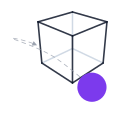
Far from means a long distance away. It contrasts most often with near/close to. If you want a movement/direction idea (keep your distance), away from is common.
Near means close in distance; far from means a long distance away.
Close to often emphasizes very short distance; far from emphasizes very long distance.
Away from often carries a 'keep your distance / move away' feeling; far from is more of a static distance description.
Quick check questions (decision tree)
Are two places or things separated by a long distance, or is a state very unlike a standard?
far from; distant from
Do you need near instead because it means close in distance; far from means a long distance away?
Near means close in distance; far from means a long distance away.
Do you need close to instead because it often emphasizes very short distance; far from emphasizes very long distance?
Close to often emphasizes very short distance; far from emphasizes very long distance.
Do you need away from instead because it often carries a 'keep your distance / move away' feeling; far from is more of a static distance description?
Away from often carries a 'keep your distance / move away' feeling; far from is more of a static distance description.
Common collocations
Places and distance
Patterns
Fixed phrases (not mainly spatial)
Common mistakes
Avoid: The cafe is far from the street. (meaning: on the other side)
Use: The cafe is across the street / across from the school.
Reason: Far from is about distance. Opposite/across is about the other side.
Avoid: He is far the station from here.
Use: The station is far from here.
Reason: Use the common pattern: far from + place (The station is far from here).
Avoid: Stand far from the edge! (as a safety instruction)
Use: Stand away from the edge.
Reason: Away from is more natural for instructions about keeping distance.
Mini quiz
Question 1
Choose the correct preposition: The hotel is ___ the beach.
Choose an answer
Question 2
Choose the correct preposition: Please stand ___ the edge.
Choose an answer
Question 3
Choose the correct preposition: His answer is ___ the truth.
Choose an answer
Quick FAQ
What does "far from" mean?+
Far from means a long distance away: The village is far from the city.
When should I use "far from"?+
Use far from when you simply describe long distance: far from here, far from home, far from the station.
Far from vs near: what's the difference?+
Near means close; far from means a long distance away. Compare: The hotel is near the beach vs far from the beach.
Far from vs close to: what's the difference?+
Close to often emphasizes very short distance; far from emphasizes very long distance.
Far from vs away from: what's the difference?+
Away from often sounds more natural for instructions (Stand away from the edge). Far from is more like a static distance description (The edge is far from here).
What does "far from perfect" mean?+
It is a fixed phrase meaning not at all perfect: The plan is far from perfect.
Far away vs far from?+
Far away can stand alone (It's far away). Far from commonly takes an object (far from home).
A 30-second memory rule for "far from"?+
Think in pairs: near/close to = close; far from = far. Then remember far from perfect = not perfect at all.