beyond
beyond; farther than, or outside a limit
- Farther than a point/edge: beyond the river, beyond the border.
- Past often means passing a point; beyond suggests farther on the far side.
- Common abstract use: beyond control / beyond repair / beyond doubt.
Controls
Drag to rotate / Scroll to zoom / Pinch to zoom
Examples
Spatial examples
The hills are beyond the river.
There is a town beyond the bridge.
Related prepositions


Key differences
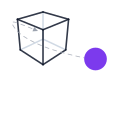
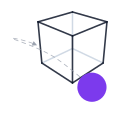
Beyond means "farther than a point/edge" or "outside a limit". It is common in both distance and abstract-limit contexts.
Past often means passing a point; beyond suggests farther on the far side of it.
Outside means not inside a boundary; beyond suggests farther than a point/boundary.
Over is the common choice for numbers (over 100). Beyond is common for limits and abstract ideas (beyond control, beyond our budget).
Quick check questions (decision tree)
Is something farther than a boundary, limit, point, or expected range?
beyond; farther than, or outside a limit
Do you need past instead because it often means passing a point; beyond suggests farther on the far side of it?
Past often means passing a point; beyond suggests farther on the far side of it.
Do you need outside instead because it means not inside a boundary; beyond suggests farther than a point/boundary?
Outside means not inside a boundary; beyond suggests farther than a point/boundary.
Do you need over instead because it is the common choice for numbers (over 100)?
Over is the common choice for numbers (over 100). Beyond is common for limits and abstract ideas (beyond control, beyond our budget).
Common collocations
Distance
Limits / range
Abstract patterns
Common mistakes
Avoid: Walk beyond the bridge and turn left. (meaning: pass the bridge)
Use: Walk past the bridge and turn left.
Reason: Past is the natural choice for passing a point. Beyond suggests farther on the far side.
Avoid: Beyond 100 people attended the meeting.
Use: Over 100 people attended the meeting.
Reason: Over is the common choice for numbers. Beyond is more common for limits/abstract ideas (beyond our budget).
Avoid: The cafe is beyond the street. (meaning: on the other side)
Use: The cafe is across the street.
Reason: Across means on the other side; beyond means farther than a point.
Avoid: It's beyond of my control.
Use: It's beyond my control.
Reason: Beyond is followed directly by a noun phrase (no of).
Mini quiz
Question 1
Choose the correct preposition: There's a small village ___ the mountains.
Choose an answer
Question 2
Choose the correct preposition: The cost is ___ our budget.
Choose an answer
Question 3
Choose the correct preposition: It's ___ my control.
Choose an answer
Quick FAQ
What does "beyond" mean?+
Beyond means "farther than a point/edge" or "outside a limit". Example: There is a town beyond the bridge.
What is the difference between "beyond" and "past"?+
Past often means passing a point (walk past the bridge). Beyond suggests farther on the far side (a village beyond the bridge).
What is the difference between "beyond" and "outside"?+
Outside means not inside a boundary (outside the gate). Beyond suggests farther than a point/boundary (the parking lot is beyond the gate).
When should I use "over" instead of "beyond"?+
Use over for numbers (over 100 people). Use beyond for limits/abstract ideas (beyond our budget, beyond control).
What are common abstract expressions with "beyond"?+
beyond control, beyond repair, beyond doubt, beyond belief, beyond recognition, beyond words.
Can "beyond" be used for time?+
Sometimes, but it is not the main beginner time preposition. Example: beyond midnight = after midnight. In many cases, after/past is more common.
What are common collocations with "beyond"?+
beyond the river, beyond the border, beyond the limit, beyond the scope, beyond my control, beyond doubt.
How can I remember "beyond" quickly?+
Think "farther than that point". Point A is your reference; beyond A is on the far side, further away.