on top of
on the highest surface of something, usually with contact
- On top of emphasizes the very top position with contact.
- Use on for neutral surface contact when top emphasis is not needed.
- Use onto for movement to the top, not static position.
Controls
Drag to rotate / Scroll to zoom / Pinch to zoom
Examples
Spatial examples
The cat sits on top of the box.
Put the lamp on top of the bookcase.
Related prepositions
Key differences
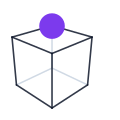
On top of means contact at the highest point. It is more specific than on, and it is not a movement preposition.
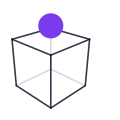
On is neutral surface contact. On top of highlights the very top position.
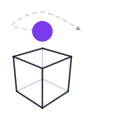
Onto expresses movement to the top; on top of expresses the final static position.
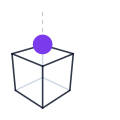
Over can mean above or crossing without contact. On top of requires contact at the top surface.
Quick check questions (decision tree)
Is something directly above and supported by, covering, or added on another thing?
on the highest surface of something, usually with contact
Do you need on instead because it is neutral surface contact?
On is neutral surface contact. On top of highlights the very top position.
Do you need onto instead because it expresses movement to the top; on top of expresses the final static position?
Onto expresses movement to the top; on top of expresses the final static position.
Do you need over instead because it can mean above or crossing without contact?
Over can mean above or crossing without contact. On top of requires contact at the top surface.
Common collocations
Physical top position
Classroom high-frequency
Extended usage
Common mistakes
Avoid: The cat is on the wardrobe. (when top emphasis matters)
Use: The cat is on top of the wardrobe.
Reason: Use on top of when you want explicit topmost-position emphasis.
Avoid: The cat jumped on top of the box.
Use: The cat jumped onto the box.
Reason: Jumped expresses movement, so onto is the better form.
Avoid: A plane flew on top of the city.
Use: A plane flew over the city.
Reason: No contact is implied, so over is correct.
Mini quiz
Question 1
Choose the correct preposition: The vase is ___ the shelf.
Choose an answer
Question 2
Choose the correct preposition: The boy climbed ___ the wall.
Choose an answer
Question 3
Choose the correct preposition: ___ that, we need more time.
Choose an answer
Quick FAQ
What is the core meaning of on top of?+
It means being in contact at the highest surface, with explicit top-position emphasis.
What is the difference between on top of and on?+
On is neutral surface contact. On top of highlights the topmost location.
How do I choose between on top of and onto?+
Use onto for movement to the top; use on top of for the final static position.
How is on top of different from over?+
Over often has no contact and may express crossing. On top of requires contact on the top surface.
Can on top of be used for time expressions?+
Not as a core time preposition. It is mainly a spatial phrase plus some discourse patterns.
What is a common learner mistake with on top of?+
Learners often use on top of for motion (should be onto) or for no-contact scenes (should be over).
What collocations should beginners memorize first?+
Start with on top of the box, on top of the shelf, on top of that, and stay on top of.
What is a 30-second memory rule for on top of?+
Ask one question: do I need 'topmost + contact' emphasis? If yes, choose on top of.