onto
onto; moving to a surface
- Movement onto a surface.
- Use on for a static position.
Scene category
Controls
Drag to rotate / Scroll to zoom / Pinch to zoom
Examples
Spatial examples
The cat jumped onto the chair.
He put the cup onto the table.
Dynamic examples
Watch the marker move onto the table.
Then trace a second path onto the platform.
Related prepositions

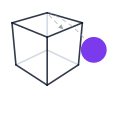

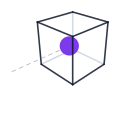
Key differences
onto mainly shows movement to a surface; compare it with similar dynamic prepositions to avoid path confusion.
Quick check questions (decision tree)
Does the movement end with the object reaching and contacting a surface?
onto; moving to a surface
Is the object already resting on the surface, with no movement toward it?
Yes -> use on. On is a static surface position; onto describes movement that reaches the surface.
Does the movement cross a boundary and finish inside an enclosed space?
Yes -> use into. Into enters an interior; onto reaches a surface.
Has someone discovered, noticed, or begun pursuing an important idea or clue?
Yes -> be onto something is an abstract extension: The detective is onto something.
Common collocations
Surface landing
Platform movement
Transport boarding
Common mistakes
Avoid: The marker moved on the table.
Use: The marker moved onto the table.
Reason: Use onto for movement to a surface; on changes the path relation.
Avoid: The ball rolled into the bed.
Use: The ball rolled onto the bed.
Reason: onto matches the intended motion; into shifts direction or endpoint meaning.
Mini quiz
Question 1
Choose the correct preposition: ___ the table.
Choose an answer
Question 2
Choose the correct preposition: ___ the bed.
Choose an answer
Question 3
Choose the correct preposition: ___ the platform.
Choose an answer
Quick FAQ
What does "onto" mean?+
onto; moving to a surface. Rule: Movement onto a surface.
When should I use "onto"?+
Use it when this relation is true: Movement onto a surface. Use on for a static position. Rule: The cat jumped onto the chair.
What is the difference between "onto" and "on"?+
onto focuses on movement to a surface, while on usually marks a different path relation. Rule: on the route
What is the difference between "onto" and "into"?+
onto highlights movement to a surface; into often changes direction or endpoint meaning. Rule: into the room
Can "onto" be used for time expressions?+
Mostly no. This preposition is primarily spatial/dynamic; use dedicated time prepositions when needed.
What is a common mistake when using "onto"?+
A frequent beginner mistake is: Avoid: The marker moved on the table. Use: The marker moved onto the table. Reason: Use onto for movement to a surface; on changes the path relation.
What are common collocations with "onto"?+
High-frequency examples: onto the table, onto the bed, onto the shelf, onto the roof, onto the floor, onto the stage
How does "onto" express movement?+
Track the movement path first, then confirm start point, direction, and endpoint.