opposite
opposite; facing directly across
- Facing each other across a space (table/street/room).
- Often similar to across from, with a stronger "face-to-face" feeling.
Controls
Drag to rotate / Scroll to zoom / Pinch to zoom
Examples
Spatial examples
The cafe is opposite the school.
His seat is opposite mine.
Related prepositions


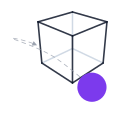

Key differences
Opposite means face-to-face across a space. It is often similar to across from, but opposite can feel more directly facing. Learners also confuse opposite with in front of (same-side front).
Across from is very close in meaning and common in American English; opposite often feels more directly facing.
In front of is on the same side, in the front position. Opposite is on the other side across a space.
Across often highlights crossing from one side to the other. Opposite is usually a static position: on the other side.
Quick check questions (decision tree)
Are two things facing or corresponding to each other on different sides?
opposite; facing directly across
Do you need across from instead because it is very close in meaning and common in American English; opposite often feels more directly facing?
Across from is very close in meaning and common in American English; opposite often feels more directly facing.
Do you need in front of instead because it is on the same side, in the front position?
In front of is on the same side, in the front position. Opposite is on the other side across a space.
Do you need across instead because it often highlights crossing from one side to the other?
Across often highlights crossing from one side to the other. Opposite is usually a static position: on the other side.
Common collocations
Places opposite
Face-to-face (people/seats)
Across a room
Common mistakes
Avoid: The cafe is opposite to the school.
Use: The cafe is opposite the school.
Reason: As a beginner pattern, use opposite + noun phrase (no to).
Avoid: The bank is in front of the school. (meaning: on the other side)
Use: The bank is opposite the school.
Reason: In front of is same-side front; opposite/across from is across a space.
Avoid: She walked opposite the street.
Use: She walked across the street.
Reason: Opposite is mostly position; across is for crossing movement.
Mini quiz
Question 1
Choose the correct preposition: She sat ___ me at the table.
Choose an answer
Question 2
Choose the correct preposition: The pharmacy is ___ the supermarket, on the other side of the street.
Choose an answer
Question 3
Choose the correct preposition: Their houses are ___ each other.
Choose an answer
Quick FAQ
What is the core meaning of opposite?+
Opposite means on the other side, often face-to-face across a space (sit opposite me).
Opposite vs across from?+
They are very close. Across from is very common in American English; opposite can feel more directly facing.
Opposite vs in front of?+
In front of is on the same side, in the front position. Opposite is across a space, on the other side.
Can opposite describe "across the street"?+
Yes. You can say opposite + place (opposite my house / opposite the bank). If you want to emphasize the street itself, across the street or across from is very common.
Do I need to say opposite to?+
For a beginner pattern, use opposite + noun phrase (opposite the school). Opposite to exists, but you do not need it first.
What does opposite each other mean?+
It means facing each other: They sat opposite each other.
Can opposite be other parts of speech?+
Yes: opposite sides (adjective) and the opposite of... (noun phrase). Those are not the preposition use.
A 30-second memory rule for opposite?+
Picture two people facing each other across a table. If it's face-to-face on the other side, think opposite/across from.