throughout
throughout; spread in the whole area
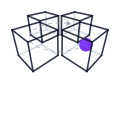
- Distributed across the entire space.
- Not a single point.
Scene category
Controls
Drag to rotate / Scroll to zoom / Pinch to zoom
Examples
Spatial examples
Lights are throughout the hall.
Trees grow throughout the park.
Time examples
Practice this time expression: throughout the process.
Another common pattern is: throughout the course.
Related prepositions
Key differences
throughout in time usage mainly signals all parts of an entire period; compare it with close alternatives to avoid overlap.
throughout focuses on all parts of an entire period, while through marks a different temporal relation.
throughout is for all parts of an entire period; over usually serves another time function.
Quick check questions (decision tree)
Is something present in every part of a place or across the whole duration of a period?
throughout; spread in the whole area
Are you describing one path or passage through the area, rather than coverage of every part?
Yes -> use through. Through follows one passage or path; throughout covers every part of the place or period.
Do you only mean sometime during a period, without saying the whole period is covered?
Yes -> over may be enough: over the weekend. Throughout stresses the entire span or every part.
Does a state remain true from the beginning to the end of the entire period?
Yes -> use throughout: throughout the year / throughout the meeting.
Common collocations
Whole-period coverage
Project coverage
Life-stage coverage
Common mistakes
Avoid: We finish through the day.
Use: We finish throughout the day.
Reason: Use throughout when the meaning is all parts of an entire period; through signals a different relation.
Avoid: The class starts over the night.
Use: The class starts throughout the night.
Reason: throughout focuses on all parts of an entire period; over is not the best fit here.
Mini quiz
Question 1
Choose the correct preposition: ___ the day.
Choose an answer
Question 2
Choose the correct preposition: ___ the night.
Choose an answer
Question 3
Choose the correct preposition: ___ the process.
Choose an answer
Quick FAQ
What does "throughout" mean?+
throughout; spread in the whole area. Rule: Distributed across the entire space.
When should I use "throughout"?+
Use it when this relation is true: Distributed across the entire space. Not a single point. Rule: Lights are throughout the hall.
What is the difference between "throughout" and "through"?+
throughout focuses on all parts of an entire period, while through marks a different temporal relation. Rule: through the night
What is the difference between "throughout" and "over"?+
throughout is for all parts of an entire period; over usually serves another time function. Rule: over the weekend
Can "throughout" be used for time expressions?+
Yes. It can be used in time expressions depending on context (point, period, or range).
What is a common mistake when using "throughout"?+
A frequent beginner mistake is: Avoid: We finish through the day. Use: We finish throughout the day. Reason: Use throughout when the meaning is all parts of an entire period; through signals a different relation.
What are common collocations with "throughout"?+
High-frequency examples: throughout the day, throughout the night, throughout the week, throughout the month, throughout the year, throughout the semester
How can I remember "throughout" quickly?+
Tie it to one clear spatial image and one short sentence. Repeat both together for 30 seconds.