around
around: surrounding; approximately
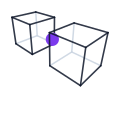
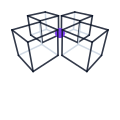
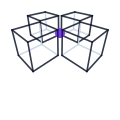
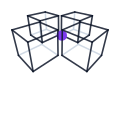
- Surrounding or encircling: sit/stand/gather around + noun.
- around + time/number = approximately: around 5 pm / around 20 people.
- Compare: about is more neutral for numbers; round is common BrE for space.
Scene category
Controls
Drag to rotate / Scroll to zoom / Pinch to zoom
Examples
Spatial examples
The kids sit around the table.
Trees grow around the house.
Time examples
Let’s meet around 5 pm.
The package should arrive around Tuesday.
It took around 10 minutes.
There were around 20 people at the meeting.
The coffee was around $10.
Dynamic examples
We walked around the park.
She drove around the city before dinner.
Related prepositions
Key differences
around in time usage mainly signals approximate time points or periods; compare it with close alternatives to avoid overlap.
Quick check questions (decision tree)
Are things surrounding a center, moving in a circle, or located nearby?
around: surrounding; approximately
Is the time exact rather than approximate?
Yes -> use at: at 7:00. Use around when the time is approximate: around 7:00.
Is the time a latest deadline rather than an approximate estimate?
Yes -> use by: finish by 7:00. Around 7:00 only means approximately that time.
Is a number, age, amount, or time only approximate?
Yes -> use around: around 20 people / around age ten / around noon.
Common collocations
Approximate points
Approximate dates
Flexible planning
Common mistakes
Avoid: We finish at noon.
Use: We finish around noon.
Reason: Use around when the meaning is approximate time points or periods; at signals a different relation.
Avoid: The class starts by 8:00.
Use: The class starts around 8:00.
Reason: around focuses on approximate time points or periods; by is not the best fit here.
Mini quiz
Question 1
Choose the correct preposition: ___ noon.
Choose an answer
Question 2
Choose the correct preposition: ___ 8:00.
Choose an answer
Question 3
Choose the correct preposition: ___ Monday.
Choose an answer
Quick FAQ
What does "around" mean?+
around: surrounding; approximately. Rule: Surrounding or encircling: sit/stand/gather around + noun.
When should I use "around"?+
Use it when this relation is true: Surrounding or encircling: sit/stand/gather around + noun. around + time/number = approximately: around 5 pm / around 20 people. Rule: The kids sit around the table.
What is the difference between "around" and "at"?+
around focuses on approximate time points or periods, while at marks a different temporal relation. Rule: at 7:00
What is the difference between "around" and "by"?+
around is for approximate time points or periods; by usually serves another time function. Rule: by Monday
Can "around" be used for time expressions?+
Yes. It can be used in time expressions depending on context (point, period, or range).
What is a common mistake when using "around"?+
A frequent beginner mistake is: Avoid: We finish at noon. Use: We finish around noon. Reason: Use around when the meaning is approximate time points or periods; at signals a different relation.
What are common collocations with "around"?+
High-frequency examples: around noon, around 8:00, around midnight, around sunrise, around lunchtime, around this time
How does "around" express movement?+
Track the movement path first, then confirm start point, direction, and endpoint.