from
from (origin/start point; source)
- Core idea: a starting point or source (where something begins/comes).
- Common pattern: from A to B (place or time range).
- Don’t mix up: since (start time + still true now) and out of (movement from inside).
Scene category
Controls
Drag to rotate / Scroll to zoom / Pinch to zoom
Examples
Spatial examples
She moved from Paris to Berlin.
The store is open from 9 a.m. to 6 p.m.
Time examples
Practice this time expression: from Monday to Friday.
Another common pattern is: from 9 to 5.
Dynamic examples
The workshop moved from Tuesday to Thursday.
Related prepositions

Key differences
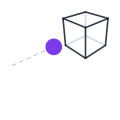
from marks an origin/source. For time, it often pairs with to for a range; since is used for a start time continuing to now; out of is movement from inside.
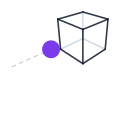
Use from for a start point in a range (often with to). Use since for a starting time when something continues to the present.
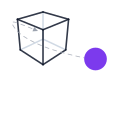
Use from for source/origin. Use out of for movement from inside an enclosed space to outside.
Quick check questions (decision tree)
Are you identifying the starting point, source, origin, or separation point?
from (origin/start point; source)
Does the situation continue from a past starting point to now or another reference time?
Use from for a start point in a range (often with to). Use since for a starting time when something continues to the present.
Does the movement specifically begin inside an enclosure and cross outward?
Use from for source/origin. Use out of for movement from inside an enclosed space to outside.
Are you identifying the person, material, cause, or document that something originates with?
Yes -> use from: a gift from Maya / made from grapes / information from the report.
Common collocations
Origin / Source
Time / Range
Distance / Separation
Common mistakes
Avoid: I have lived here from 2019.
Use: I have lived here since 2019.
Reason: With the present perfect for a situation continuing to now, use since + a start time, not from.
Avoid: The store is open from 9 until 6.
Use: The store is open from 9 to 6.
Reason: For a clear range with two endpoints, the most common pattern is from A to B.
Avoid: He walked from of the room.
Use: He walked out of the room.
Reason: Use out of for movement from inside an enclosed space. From focuses on the source/start point.
Mini quiz
Question 1
Choose the best option: The shop is open ___ 9 a.m. to 6 p.m.
Choose an answer
Question 2
Choose the best option: I have known her ___ 2020.
Choose an answer
Question 3
Choose the best option: She took the book ___ her bag.
Choose an answer
Quick FAQ
What does "from" mean?+
From marks an origin or source: where something starts or where it comes from.
How do I use "from" in a simple pattern?+
Use from + place/person/thing: from London, from my friend, from the internet.
How do I talk about a time range with "from"?+
Use from A to B: The store is open from 9 a.m. to 6 p.m.
From vs since: what's the difference?+
From often pairs with to for a range. Since is used for a start time continuing to now (I have lived here since 2019).
From vs out of: what's the difference?+
From is source/origin (a message from her). Out of is movement from inside to outside (out of the room).
What are common collocations with "from"?+
High-frequency: come from, be from, hear from, learn from, protect from, different from.