to
to: toward an endpoint; to a recipient; up to a limit
- Endpoint/destination: move to a place or point.
- Recipient/target: give/send/show something to someone.
- Quick check: preposition to + noun/pronoun/gerund; infinitive to + base verb.
Scene category
Controls
Drag to rotate / Scroll to zoom / Pinch to zoom
Examples
Spatial examples
She walks to the door.
The bus goes to the station.
Time examples
Practice this time expression: give it to me.
Another common pattern is: send an email to the team.
Dynamic examples
The timeline shifted to next Monday after the update.
Related prepositions



Key differences
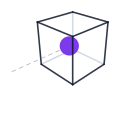
To points to an endpoint/target: destination (go to…), recipient (give to…), or a range endpoint (from…to…). Quick check: preposition to + noun/pronoun/gerund; to + base verb is usually the infinitive marker.
Toward emphasizes direction without guaranteed arrival; to highlights the endpoint.
Into means movement from outside to inside; to does not necessarily imply entering.
At is a static point/location; to is movement to that point.
For often marks purpose/benefit; to often marks direction/recipient/target.
Quick check questions (decision tree)
Does the movement, transfer, or range have a definite destination or endpoint?
to: toward an endpoint; to a recipient; up to a limit
Do you need toward instead because it emphasizes direction without guaranteed arrival; to highlights the endpoint?
Toward emphasizes direction without guaranteed arrival; to highlights the endpoint.
Do you need into instead because it means movement from outside to inside; to does not necessarily imply entering?
Into means movement from outside to inside; to does not necessarily imply entering.
Do you need at instead because it is a static point/location; to is movement to that point?
At is a static point/location; to is movement to that point.
Common collocations
Destination / endpoint
Recipient / target
Range / limit
Common mistakes
Avoid: I want to school.
Use: I want to go to school.
Reason: To is a preposition before a noun (to school). After want, to + base verb is the infinitive marker (to go).
Avoid: I look forward to see you.
Use: I look forward to seeing you.
Reason: Here to is a preposition after look forward; it needs a noun/gerund, not a base verb.
Avoid: We arrived to the airport.
Use: We arrived at the airport.
Reason: Arrive uses at/in, not to (arrive at the airport / arrive in London).
Avoid: Between 9 to 5
Use: From 9 to 5 / Between 9 and 5
Reason: Use from…to… for a range; between pairs with and.
Mini quiz
Question 1
Choose the best option: She walked ___ the door.
Choose an answer
Question 2
Choose the best option: I decided ___ leave early.
Choose an answer
Question 3
Choose the best option: I look forward to ___ you again.
Choose an answer
Quick FAQ
What does the preposition "to" mean?+
As a preposition, to points to an endpoint or target: destination (go to school), recipient (give it to me), or a range limit (from 9 to 5).
Preposition to vs infinitive to: how can I tell?+
If to is followed by a noun/pronoun/gerund, it is a preposition (to the station / to me / to seeing you). If it is followed by a base verb, it is usually the infinitive marker (to go / to learn).
To vs toward: what's the difference?+
Toward emphasizes direction and does not guarantee arrival. To highlights the endpoint: walk toward the door (maybe stop) vs walk to the door (reach it).
Can I use to after "look forward"?+
Yes, but to is a preposition there, so use a noun or gerund: look forward to the weekend / look forward to seeing you.
Do we say arrive to a place?+
No. Use arrive at (a point) or arrive in (a city/country): arrive at the airport / arrive in London.
How do I express a range with to?+
Use from X to Y, or X to Y in lists/timetables: from 9 to 5 / Monday to Friday / 10 to 12.