


Prepositions are difficult because they describe relationships rather than objects. A learner can name a thing quickly, but a relationship has to be seen, compared, and felt in context. That is why prepositions often seem simple at first and then become unstable in real use.
Help English beginners worldwidelearn one preposition in 3 seconds
Master 50 prepositions in one day
in
inside; enclosed by boundaries
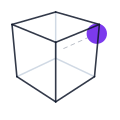
View detail >Drag the purple ball and watch the preposition update in real time.
Preposition Gallery
Spatial prepositions
Focus on location relations: inside/outside, above/below, front/back, near/far.

above
higher than something and not touching it; also higher than a level, number, or standard
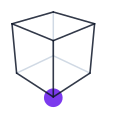
below
at a lower level; lower than a reference point or standard

beside
at the side of; next to, usually very close

next to
immediately beside; directly adjacent to

near
near; close in distance (not necessarily adjacent)

by
by: at the side of; also used for deadlines, method, basis, and amount.

in front of
in front of (outside; facing)

among
within a group; surrounded by many people/things

inside
inside; within

outside
outside; not inside a place or boundary

against
touching and pressing to a surface (with support/pressure)

beneath
under; below in a formal or literary tone

underneath
directly under, often close to the underside

without
without; outside boundaries

across from
across from; on the opposite side

opposite
opposite; facing directly across

amid
amid; in the middle of

amidst
amidst; same as amid

beyond
beyond; farther than, or outside a limit

on top of
on the highest surface of something, usually with contact

in the middle of
in the middle of; at the center
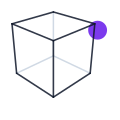
in back of
behind (informal AmE)

close to
very near; at a short distance from

far from
far from; distant from

away from
away from: away from / keep distance from.
Time prepositions
Focus on time points, durations, and deadlines.

in
inside; enclosed by boundaries

on
touching a surface; (time) used with days and dates

under
below and often covered by something above; also less than a limit

behind
at the back of; at the rear (also: late in progress)

between
between; in the middle of two

at
at; a specific point or place

after
later than; following in time

within
within: inside a limit or boundary

throughout
throughout; spread in the whole area

upon
upon; on (formal); (upon + noun) when/as soon as

ahead of
ahead of; in front of

since
since: marks a time starting point, and sometimes the reason a judgment starts from.

until
until: continue up to a time boundary.

during
during: in the course of a period or event.
Dynamic prepositions
Focus on movement paths, direction, and start-end transitions.

over
above and across; during a period; more than a number

around
around: surrounding; approximately
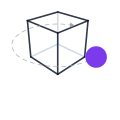
about
about: around, concerning, or approximately.

across
across; to the other side
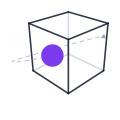
through
through; by going inside (passing within)

along
along; following a line

into
into; moving inside

onto
onto; moving to a surface

out of
out of; moving outside

to
to: toward an endpoint; to a recipient; up to a limit
from
from (origin/start point; source)

up
up; upward or above

down
down; downward or below

off
off; away from a surface

past
past; beyond a point (passing it)

toward
toward; in the direction of

alongside
alongside; at the side, parallel

via
via: by way of / through a channel.
Abstract prepositions
Focus on basis, substitution, inclusion, cause, and channel relations.
Method and learning questions
FAQ · How This Site Teaches Prepositions
Spatial meaning is usually the most concrete entry point into the system of prepositions. When the core image becomes clear, the word is easier to remember, compare, and extend. Many later uses in time and abstraction make more sense once that first spatial model is stable.
Because prepositions depend on position, orientation, and viewpoint. A flat explanation often hides the very distinction a learner needs to notice. A simple 3D scene makes the relationship easier to inspect from different angles, which leads to a cleaner mental image.
Because confusion usually lives in the gap between similar words. A learner does not struggle with one preposition in isolation as much as with the boundary between nearby choices. Comparison sharpens that boundary and helps the brain notice the one feature that actually controls the choice.
Because clarity matters more than verbal volume. The purpose of an example here is not to display complex English, but to anchor one preposition to one clear situation. Short explanations reduce cognitive load and leave more attention for the relationship itself.
Move through it slowly and comparatively. Start with a small group of spatial prepositions, study the scene, read the explanation, compare nearby alternatives, and then test yourself. It is better to build a precise image of a few words than to rush through many without distinction.
Yes. Once the spatial core is understood, many time-related and abstract uses feel less arbitrary. The learner begins to see how meanings expand from one relationship instead of memorizing each use as a disconnected rule.
Because translation alone rarely captures the full relationship. Two prepositions may look similar in another language, yet differ in boundary, contact, direction, distance, or perspective. Real mastery begins when the learner can recognize the pattern underneath the label.
Grammar can name a pattern, but it does not always make the pattern visible. For beginners, the real obstacle is usually not terminology but vagueness. Space makes the relationship explicit, so the learner can understand first and formalize later.
A relationship becomes more memorable when the learner actively explores it. Dragging, rotating, and observing change turn a preposition from a sentence-level rule into an experienced pattern. Active attention usually creates stronger recall than passive reading alone.
Because depth is more useful than overload at the beginning. If learners meet too many meanings at once, the word becomes diffuse before it becomes clear. Starting with the most common and most teachable use gives the learner a stable center of gravity.
Bilingual support lowers friction without replacing thinking. It helps beginners confirm meaning quickly, so they can spend less energy decoding and more energy noticing the structure of the preposition. The translation supports the image instead of competing with it.
Both. Individual learners can use it to build intuition step by step, while teachers and parents can use the visuals to explain quickly and concretely. The method is designed to reduce abstraction and make explanation easier in either setting.